



Use case
Give contractors the access they need — and take it back on schedule
Contractors, vendors, and temporary crews move through your site every day. Duall Master issues time-boxed credentials, ties every entry to an identity and a host, and revokes access automatically when the job ends — no spreadsheets, no orphaned cards.
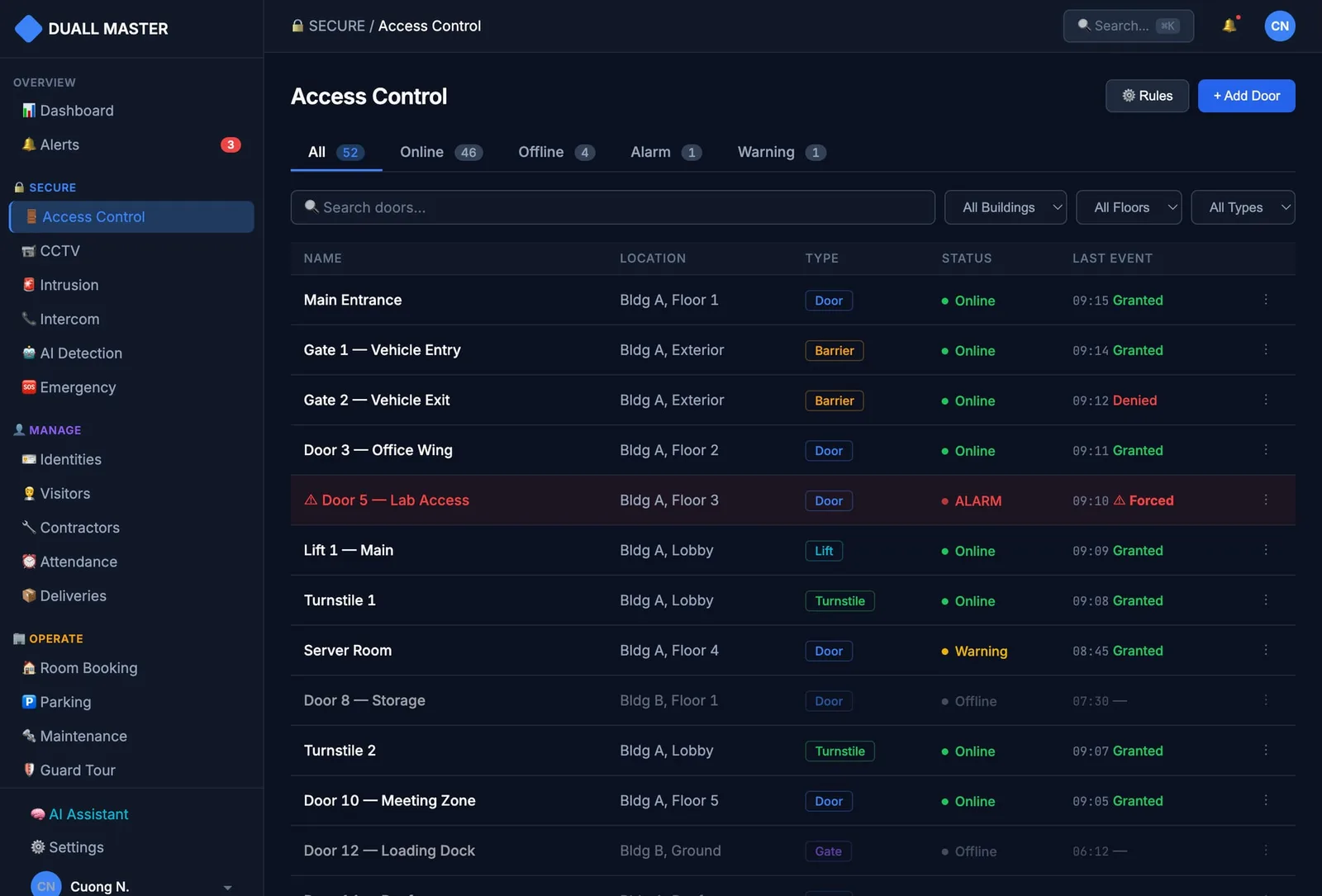
One command surface
Module-by-module rollout
Audit-friendly operations
How it plays out
The scenario, step by step on one timeline.
Each step ties to a real platform action — not a slideshow.
- 01
Onboard
A contractor is added with a role, the zones they need, and a validity window — no permanent card.
- 02
On site
They badge in by card, QR, or face; every entry is tied to their identity and sponsoring host.
- 03
Exception
An attempt outside their zone or window is denied and logged with full context.
- 04
Job closes
Access expires on schedule — or is revoked in one action — and the entry history stays auditable.
Before and after
Before Duall Master
Temporary workers issued permanent cards that never come back
No single record of who is on site, for which job, under whose sponsorship
Manual onboarding that slows down the first day and the audit later
Access that should have ended weeks ago but is still live
After Duall Master
Shared identity, policy, and site structure
Live events with module context attached
Governed operator actions with audit history
Phased expansion without replatforming
Most relevant modules
Module combinations for this use case
This use case starts with the module that solves the clearest operational pain, then expands on the same foundation.
Module stack
One operating picture, assembled module by module.
Shared foundation
Live operations layer
Access, visitors, parking, video, intercom, and audit events resolve into the same command surface.
Field references
Deployments that ground this use case
Real customer references delivering capabilities now packaged as Duall Master — scope, hardware, and figures sourced from project documentation.
Access Control + Visitor Management + Time Attendance · 2026
TIL International Port
A busy international container port never really closes — workers, drivers, and visitors move through its gates around the clock. At TIL’s Hải Phòng terminal, Duall Master keeps that flow secure and accountable: staff enter by face or card, visitors are managed at the gate, and the same recognized entry becomes the attendance record.
Access Control + Visitor Management + Time Attendance · 2024
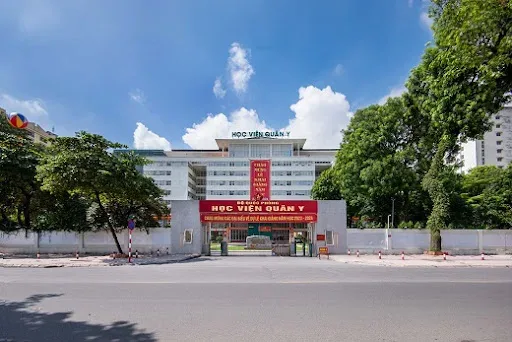
Vietnam Military Medical University
A military medical university running access control, chip-ID visitor registration, and attendance for nearly 8,000 staff, students, and clinicians on one platform — face-recognition entry across the unit and citizen-ID check-in at patient reception.
Access Control + Visitor Management + Time Attendance · 2023
Children's Hospital 1
Children's Hospital 1, one of Ho Chi Minh City's largest paediatric hospitals, runs access control, visitor management, and staff attendance for roughly 10,000 people on one on-premise Duall Master platform — 84 doors and 14 lifts governed together and integrated with the hospital's management system.
Scenario operating model
Contractor access management needs connected site signals, not another point solution.
Modules in play
- 01
Signal
Doors, visitors, cameras, intercoms, and parking generate live signals — not isolated alerts.
- 02
Context
Identity, policy, site, zone, and related module records attach to every signal.
- 03
Action
Operators approve, deny, review, or escalate inside one governed workspace.
- 04
Audit
Every decision keeps the who, what, when, and evidence — ready for review.
Buyer-facing model for phased adoption: start with the clearest pain, then add adjacent modules on the same foundation.
Deployment and trust
Typical adoption path
- 01Define contractor roles, zones, and validity windows
- 02Onboard crews with time-limited card, QR, or face credentials
- 03Review entries and revoke access the moment a job closes
Next step
Discuss Duall Master for Contractor access management
Review module priorities, deployment constraints, integrations, and rollout path for your environment.